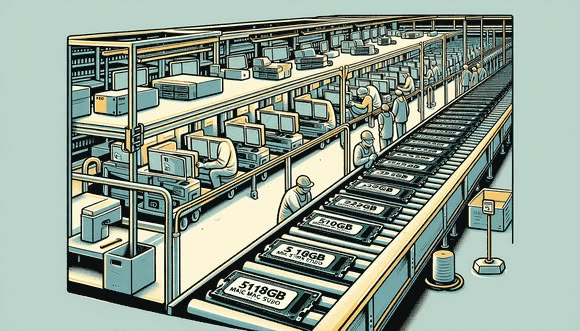
There’s a quiet war happening inside every build, and it isn’t being fought in the GPU aisle. It’s happening in the memory modules — the unglamorous rows of DRAM and NAND that every operative takes for granted until the price tag stops making sense.
Across the industry this month, the pattern has repeated itself with unsettling consistency. Console makers have raised hardware prices mid-cycle — a move that almost never happens once a platform matures. Component manufacturers are openly warning that storage and memory costs remain under sustained pressure. Analysts are calling it what it is: an AI-era memory shortage, and it’s no longer confined to the data center. It has crossed the perimeter into consumer hardware — into the machines people build for gaming, for creative work, for the desks where real work gets done.
The mechanics are straightforward, even if the consequences aren’t. Every hyperscaler racing to stand up AI infrastructure needs staggering volumes of high-bandwidth memory. That demand doesn’t stay contained to enterprise-grade silicon — it pulls on the same fabs, the same wafer allocations, the same supply chains that produce the RAM and SSDs going into every custom tower on the market. When the data center wins the allocation war, the rest of the industry absorbs the shortage. Manufacturers have confirmed pricing pressure is spreading well beyond gaming consoles and into the broader consumer electronics category.
What this means at the bench.
For an operation like ours, this isn’t abstract market noise — it’s a direct input into every spec sheet we sign off on. Component sourcing has always been part engineering, part intelligence work: knowing which suppliers hold steady inventory, which SKUs are about to be reallocated, and which configurations are worth locking in before the next price adjustment lands. That discipline matters more now than it has in years.
It also reinforces something we’ve held as doctrine since Nightglass shipped its first unit: overbuilding the memory subsystem isn’t a luxury upgrade, it’s insurance. A build specced with headroom today is a build that doesn’t need to be re-opened, re-sourced, and re-priced eighteen months from now when the shortage tightens further.
The takeaway.
Markets built on scarcity reward operatives who move early and think in systems, not single components. We’re watching the memory market the way we watch everything else that goes into a build: closely, skeptically, and with a plan for what happens when the numbers move again.